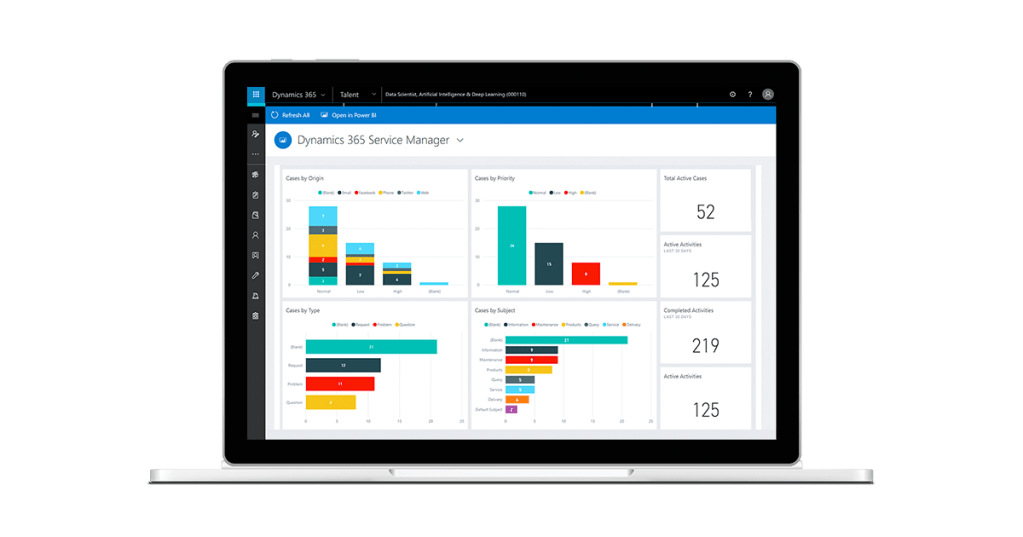
Dynamics 365 Customer Service is a powerful solution that helps you provide personalized, proactive, and omnichannel support to your customers. With Dynamics 365 Customer Service, you can:
- Manage cases efficiently and effectively with automated workflows, intelligent routing, and SLA tracking.
- Empower your agents with a unified interface that gives them access to relevant customer data, knowledge articles, and AI-powered suggestions.
- Engage your customers across multiple channels, including web, email, phone, chat, SMS, and social media.
- Leverage AI and analytics to gain insights into customer satisfaction, agent performance, and service trends.
- Optimize your service operations with self-service portals, chatbots, surveys, and feedback mechanisms.
In this blog post, we will explore some of the key capabilities of Dynamics 365 Customer Service and how you can use them to deliver exceptional customer experiences.
Case Management
One of the core features of Dynamics 365 Customer Service is case management. A case is a record of a customer’s request or issue that needs to be resolved by your service team. Cases can be created from various sources, such as emails, phone calls, web forms, or social media posts. You can also create cases manually or automatically based on predefined rules.
Cases are assigned to agents based on their skills, availability, and workload. You can also use queues to organize and prioritize cases according to different criteria, such as urgency, status, or category. Agents can view and update cases from the Customer Service Hub app, which provides them with a comprehensive view of the customer’s history, interactions, and preferences.
To help agents resolve cases faster and more effectively, Dynamics 365 Customer Service offers several tools and features, such as:
- Automated workflows that trigger actions or notifications based on case events or conditions.
- SLA tracking that monitors the progress and performance of cases against predefined service level agreements.
- Knowledge articles that provide relevant information and guidance to agents and customers.
- AI-powered suggestions that recommend the best actions or responses for each case.
- Email templates that enable agents to send consistent and professional messages to customers.
- Entitlements that define the level and type of service that each customer is eligible for.
Omnichannel Engagement
Another key capability of Dynamics 365 Customer Service is omnichannel engagement. Omnichannel engagement means that you can interact with your customers across multiple channels and devices, while maintaining a consistent and seamless experience. With Dynamics 365 Customer Service, you can support the following channels:
- Web: You can embed a web widget on your website that allows customers to contact you via chat or email, or access self-service options such as knowledge articles or chatbots.
- Email: You can use the built-in email functionality to send and receive emails from customers. You can also integrate with Outlook or Exchange to sync your email activities with Dynamics 365.
- Phone: You can use the built-in telephony functionality to make and receive phone calls from customers. You can also integrate with third-party telephony providers to leverage advanced features such as IVR, call recording, or call analytics.
- Chat: You can use the built-in chat functionality to have real-time conversations with customers via text or video. You can also integrate with third-party chat providers such as Microsoft Teams or Facebook Messenger to extend your reach and capabilities.
- SMS: You can use the built-in SMS functionality to send and receive text messages from customers. You can also integrate with third-party SMS providers such as Twilio or Plivo to support more regions and languages.
- Social media: You can use the built-in social media functionality to monitor and respond to customer posts on platforms such as Twitter or Facebook. You can also integrate with third-party social media providers such as Hootsuite or Sprinklr to manage your social media presence more effectively.
All these channels are integrated with Dynamics 365 Customer Service, which means that you can:
- Track and record all customer interactions in a single place.
- Switch between channels seamlessly without losing context or history.
- Route and escalate cases across channels based on predefined rules or criteria.
- Provide personalized and relevant responses based on customer data and preferences.
- Analyze and measure the performance and impact of each channel.
AI and Analytics
The third key capability of Dynamics 365 Customer Service is AI and analytics. AI and analytics help you leverage data and intelligence to improve your service quality and efficiency. With Dynamics 365 Customer Service, you can use AI and analytics to:
- Predict customer needs and expectations using sentiment analysis, natural language understanding, and machine learning.
- Automate repetitive tasks and processes using bots, workflows, and robotic process automation (RPA).
- Enhance agent productivity and satisfaction using agent assist, smart assist, and gamification.
- Optimize service outcomes and costs using resource scheduling optimization (RSO), demand forecasting, and capacity planning.
- Gain insights into customer behavior and feedback using customer voice, customer insights, and customer service analytics.
If you want to learn more about Dynamics 365 Customer Service and how it can help you transform your service delivery, contact us today.
Conclusion
Dynamics 365 Customer Service is a comprehensive and flexible solution that enables you to provide exceptional customer service across multiple channels and devices. By using Dynamics 365 Customer Service, you can:
- Manage cases efficiently and effectively with automated workflows, intelligent routing, and SLA tracking.
- Empower your agents with a unified interface that gives them access to relevant customer data, knowledge articles, and AI-powered suggestions.
- Engage your customers across multiple channels, including web, email, phone, chat, SMS, and social media.
- Leverage AI and analytics to gain insights into customer satisfaction, agent performance, and service trends.
- Optimize your service operations with self-service portals, chatbots, surveys, and feedback mechanisms.
 Crm Minds
Leave a comment